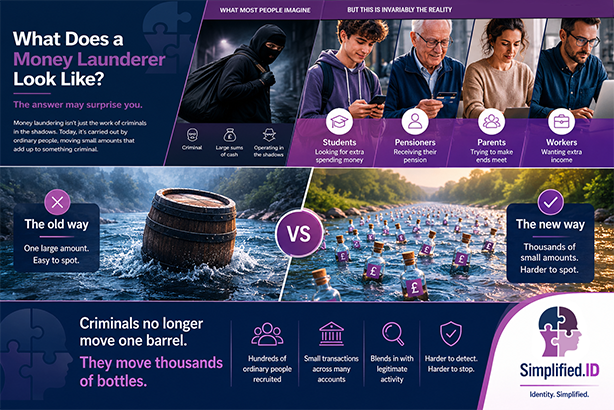
Close your eyes and picture a money launderer. What do you see?

For most people, the image is remarkably similar. A hardened criminal. A masked figure carrying a bag full of cash. Someone operating from the shadows, moving millions through offshore accounts and complex corporate structures.
Hollywood has done an excellent job of creating this image. The problem is that it is largely wrong.
The modern face of money laundering is often not a career criminal at all. It may be a sixteen-year-old student saving for a new phone. A university graduate struggling with living costs. A retired pensioner supplementing their income. A single parent trying to make ends meet. They do not see themselves as criminals. Many do not even realise they are participating in money laundering.
The Criminals Have Changed the Business Model
Traditionally, money laundering involved moving large sums of criminal proceeds through a relatively small number of accounts and businesses. That created risk. Large transactions attract attention. Banks monitor unusual activity. Compliance teams investigate suspicious behaviour. Law enforcement follows the money.
Criminals adapted. Rather than asking one person to move £100,000, they now recruit hundreds of people to move £100 each.
The mathematics is simple.
One hundred people moving £100 each generates £10,000.
One thousand people moving £100 each generates £100,000.
Ten thousand people moving £100 each generates £1 million.
The individual transactions appear insignificant. The collective result is enormous.
The Human Conveyor Belt
Imagine a criminal organisation standing beside a river. In the past, they attempted to push a single large barrel of money across the water. It was visible. Heavy. Easy to spot.
Today, they float thousands of small bottles downstream instead. Each bottle is tiny. Most people would barely notice one passing by. But when thousands travel together, they carry exactly the same volume as the barrel.
Modern money laundering often works in much the same way. Criminals create a human conveyor belt made up of ordinary people. Each person handles a small amount of money. Each transaction appears harmless in isolation. Yet together they form a sophisticated laundering network.
The Rise of the Money Mule
The financial industry has become familiar with the term “money mule.” A money mule is someone who allows their bank account to be used to receive and transfer funds on behalf of another person. Recruitment methods are often surprisingly simple.
“Work from home.”
“Earn £200 a week.”
“Use your bank account and keep a commission.”
“Help process payments for our company.”
The advertisements may appear on social media, messaging platforms or online job boards. For a teenager looking for spending money, the offer can seem attractive. For someone struggling financially, it can feel like a heaven sent opportunity.
For criminals, it is a low-cost, highly effective, often anonymous laundering mechanism.
Why Detection Has Become More Difficult
A bank receiving a £500,000 transfer will almost certainly take notice.
Many banks and accounts receiving hundreds of transactions worth £200, £300 or £500 is invariably invisible, irrespective it would present a very different challenge. The activity is fragmented. The risk is distributed. The money is spread across numerous accounts, institutions and individuals. This is precisely why criminals use this model. They are not merely moving money. They are deliberately hiding within normality. The greatest disguise in modern financial crime is not a mask. It is appearing ordinary.
The Dangerous Assumption
One of the biggest risks facing organisations is the belief that financial crime can be identified by appearance, it cannot.
There is no typical money launderer.
The pensioner receiving a small payment.
The student moving money between accounts.
The office worker responding to an online advert.
The self-employed individual offered a commission for handling transactions.
None fit the stereotype. Yet any could unknowingly become part of a laundering network.
When compliance professionals, firms and financial institutions think about money laundering, the focus should not be on what a criminal looks like.
The focus should be on behaviour
- Patterns.
- Relationships.
- Transactions.
Because in 2026, the person helping to launder criminal proceeds may not resemble the criminal image we have carried in our minds for decades. They may look exactly like the person standing next to us in the supermarket queue. Or looking back at us in the mirror.